
Knowledge · Tool
Cyberdelic XD Canvas
By Jose Montemayor Alba
Cyberdelic Experience Design combines technology, psychology, and storytelling to create meaningful experiences. The Cyberdelic XD Canvas is a tool for mapping immersive experiences, focusing on elements like audience needs, objectives, sensory engagement, and the flow of experience. It emphasizes holistic design thinking and encourages ethical, transformative practices while facilitating rapid prototyping of experiences that foster awareness and connection.
- Kind
- ToolFeatured7 tools in the bank
- Published
- 2025Where it sits among everything in the Knowledge Bank, by year
- Author
Topics
Summary
About the tool
Welcome!! This is acomprehensive guide to understand how to use the Cyberdelic XD Canvas
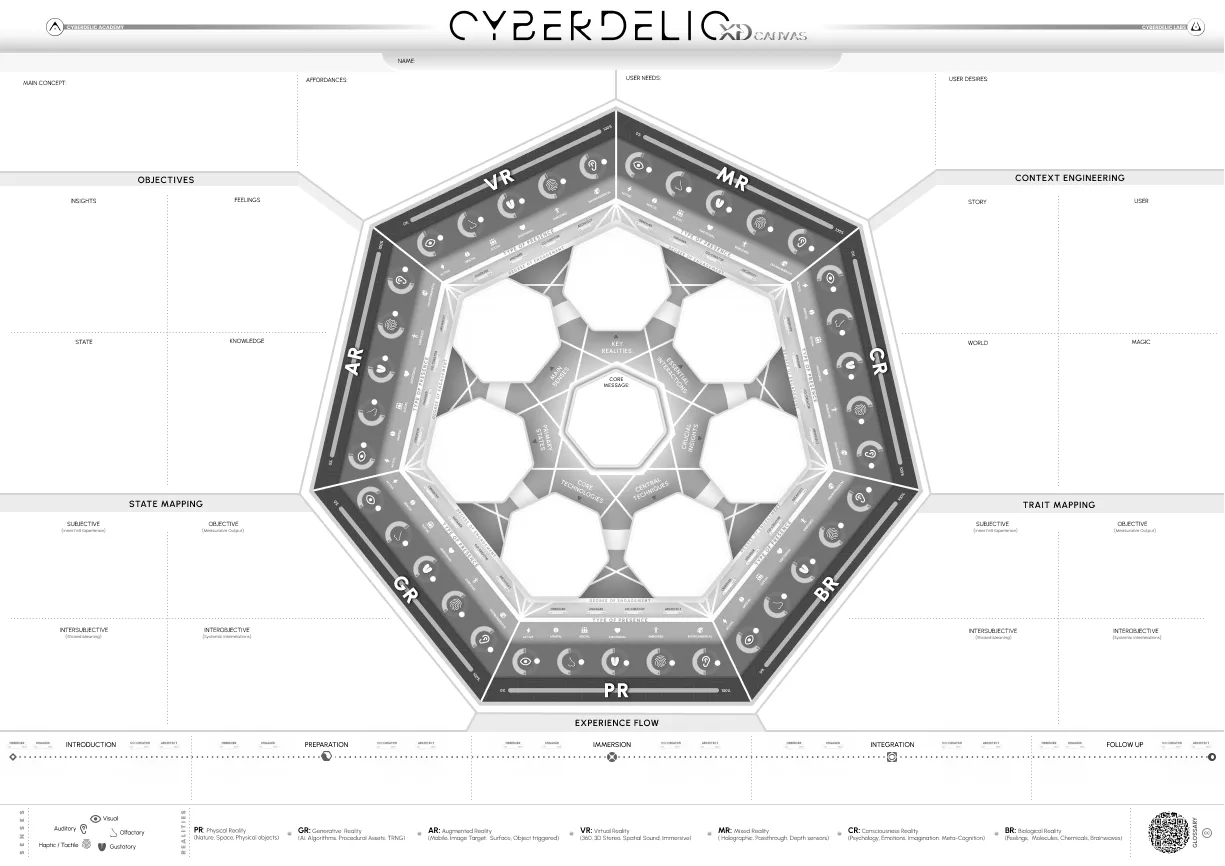
What is Cyberdelic Experience Design?
Cyberdelic Experience Design is a transdisciplinary methodology that synthesizes technology, psychology, storytelling, and learning science to architect meaningful experiences at the threshold between code and consciousness.
Drawing from ontological design, learning experience design, integral psychology, context engineering, hyper-reality design, and humane technology, it embodies a core cybernetic principle: we shape our realities through feedback loops that, in turn, shape us back.
More than mere interaction design, Cyberdelic Experience Design is rooted in the ancient art of navigation, where we learn to steer rather than control, to attune rather than dominate.
It blends digital immersion, sensory engagement, and meaning-making frameworks to cultivate expanded states of awareness, creating participatory feedback systems that restore agency, coherence, and revelation in an age of algorithmic influence.
In essence: it's the conscious craft of designing experiences that don't just entertain or inform, but reflect, reveal, and refine perception itself, honoring the participatory knowing that binds us reciprocally to the systems we inhabit.
What is the Cyberdelic XD Canvas?
The Cyberdelic XD Canvas is a systems-thinking tool for mapping and prototyping immersive, meaningful experiences.
It helps teams visualize how sensory, psychological, and technological elements weave together into a coherent journey.
Use it to:
- Define your concept and intentions.
- Map user states and desired traits.
- Balance sensory, emotional, cognitive, and systemic dimensions.
- Align your experience flow from introduction to integration.
Main Components
1. Name, Concept & Core Message
The foundation of your experience.
- Name: A title that captures the essence or mythos of the project.
- Main Concept: The driving idea or question behind the experience.
- Core Message: The insight or transformation you want participants to take away.
Example:
Name – The Lucid Garden
Concept – A meditative AR experience that makes plant communication audible.
Core Message – “When you listen, nature speaks.”
2. Audience: Needs, Desires
Understanding your audience ensures relevance and emotional resonance.
- Needs: What challenges or unmet desires bring them here?
- Desires: What do they wish to feel, learn, or become?
Example:
Festival goers seeking decompression → desire for reconnection with the body
3. Objectives & Outcomes
These anchor the design process and measure its impact.
They can target Behavior, Insight, State, or Knowledge.
| Category | Objective (Before) | Outcome (After) |
|---|---|---|
| Behavior | Encourage stillness | Participants slow down naturally |
| Insight | Reveal unity of self and environment | Verbal reflections show expanded empathy |
| State | Evoke awe | Participants report flow and wonder |
| Knowledge | Teach breath awareness | Users recall and apply techniques |
4. Reality Planes
Every experience unfolds across one or more realities — physical, virtual, biological, or cognitive.
Designers can mix these to craft layered realities.
| Code | Reality | Examples |
|---|---|---|
| PR | Physical Reality | Space, materials, nature, physical props |
| VR | Virtual Reality | Headset-based immersive worlds |
| AR | Augmented Reality | Mobile or headset overlays, image tracking |
| MR | Mixed Reality | Holographic projection, depth-sensing |
| GR | Generative Reality | AI, procedural or algorithmic content |
| BR | Biological Reality | Biometric feedback, neuro-interfaces, breath sensors |
| CR | Cognitive Reality | Imagination, emotions, dreams, meta-cognition |
Designers can rate how much each plane is engaged (0–100%) to visualize the “stack” of realities shaping the experience.
5. Sensory Domains
The senses are the gateways to transformation.
The circular sensory map shows which perceptual channels the experience engages.
| Sense | Description | Example |
|---|---|---|
| Visual | Light, color, shape, visual rhythm | Projections, VR worlds |
| Auditory | Sound, silence, spatial audio | Binaural beats, generative soundscapes |
| Olfactory | Smell | Diffused essential oils |
| Gustatory | Taste | Edible installations, ritual tea |
| Haptic / Tactile | Touch, vibration, texture | Haptic feedback, physical artifacts |
| Interoception (Body Awareness) | Inner bodily sensations | Breath, heartbeat, proprioception cues |
Each can be rated by intensity to balance sensory design.
6. Degree of Engagement
Represents how actively participants shape the experience.
| Level | Description | Example |
|---|---|---|
| Observer | Passive witness | Watching a projection |
| Engager | Interacts or reacts | Responds to visuals or sound |
| Co-Creator | Contributes content or action | Generates visuals through motion or voice |
| Architect | Shapes or directs the system | Facilitator, designer, or emergent AI collaborator |
The degree can shift across the Experience Flow stages.
7. Type of Presence
Presence emerges through six experiential dimensions, each measurable from 0–100%.
These help teams design balanced engagement across body, mind, emotion, and environment.
| Presence Type | Description |
|---|---|
| Mental | Cognitive focus, lucidity, awareness |
| Emotional | Affective engagement, empathy, awe |
| Social | Connection with others, collective flow |
| Embodied | Physical sensation, movement, grounding |
| Environmental | Relationship with surroundings or space |
| Active | Dynamic participation, agency, play |
8. Experience Flow
The journey unfolds through five temporal stages.
Use this section to script the transformation arc.
- Introduction – Orient the participant.
- Preparation – Prime intention or context.
- Immersion – Core transformative encounter.
- Integration – Meaning-making and reflection.
- Follow-Up – Continuity or call to action.
9. State Mapping
Defines the immediate experiential states you aim to evoke.
It uses four quadrants inspired by Integral Theory:
| Dimension | Description | Example |
|---|---|---|
| Subjective | Inner felt experience (emotions, thoughts, perception) | Calm, curiosity, wonder |
| Objective | Observable, measurable changes (behavior, biofeedback) | Slowed heart rate, steady gaze |
| Intersubjective | Shared meaning, collective sensemaking | Group empathy, laughter, synchronized breathing |
| Interobjective (Systemic) | Interaction with larger systems (technology, ecology, culture) | Real-time AI feedback, ecological awareness |
Design Tip:
Map where the core of your experience sits, and how participants might move through quadrants as it evolves.
10. Trait Mapping
Translates temporary states into lasting traits.
This ensures the experience has integration value beyond the event.
| Dimension | Description | Example Trait Developed |
|---|---|---|
| Subjective | Internal capacities | Self-awareness, emotional regulation |
| Objective | Skills or measurable habits | Focus, posture, breathing technique |
| Intersubjective | Relational qualities | Compassion, collaboration |
| Interobjective (Systemic) | Awareness of systems and ethics | Ecological literacy, tech mindfulness |
Compare your State Map and Trait Map to check alignment: are the sensations you’re inducing likely to produce the transformation you intend?
11. Context Engineering
Design the environmental and social conditions that shape meaning.
Lighting, rhythm, symbols, narrative, and facilitation all influence how participants interpret their experience.
12. Magic, Story, World, User
These inner-core cells express the creative and mythic dimension:
- World: The universe or setting where the experience unfolds.
- Story: The sequence or structure guiding the participant’s journey.
- Magic: The transformation mechanism — the “how” behind the change.
- (Magic = mechanism of meaning.)
- User: The participant or audience — their context, needs, and role in co-creating the experience.
How to Use the Canvas
- Start with Intention — Define your concept, purpose, and audience.
- Map Realities and Senses — Decide which planes and senses to engage.
- Design Flow — Sketch the participant journey through the five stages.
- Map States and Traits — Clarify immediate experiences and long-term takeaways.
- Balance Presence and Engagement — Adjust the six presence types and four engagement levels.
- Prototype and Reflect — Use the percentages and sliders to visualize emphasis.
- Integrate Feedback — Observe, adjust, and realign objectives and outcomes.
Why Use It
- Ensures holistic design thinking across body, mind, culture, and system.
- Helps teams prototype immersive experiences rapidly.
- Encourages ethical, transformative, and inclusive design practices.
Key Terms Quick Reference
| Term | Definition |
|---|---|
| Cyberdelic | From “cybernetics” and “psychedelic”: technology used to expand consciousness rather than distract it. |
| Ontological Design | The practice of designing environments that in turn design us. |
| Interoception | Awareness of internal bodily sensations. |
| State → Trait | The process by which temporary experiences lead to long-term change. |
| State | A temporary, transient experiential condition (e.g., flow, awe, relaxation) that arises during an experience. |
| Trait | A stable, enduring quality or capacity (e.g., resilience, empathy, mindfulness) developed through repeated states. |
| Interobjective | The systemic, collective structures (technology, culture, institutions) that shape and are shaped by experience. |
| Intersubjective | The shared, relational space of meaning-making between individuals—where empathy, dialogue, and co-created understanding emerge. |
| Affordances | The action possibilities that an environment or object offers to a participant—what it invites or enables them to do. |
Want to learn more about how to design Cyberdelic Experiences? Check out this course
Related
More like this
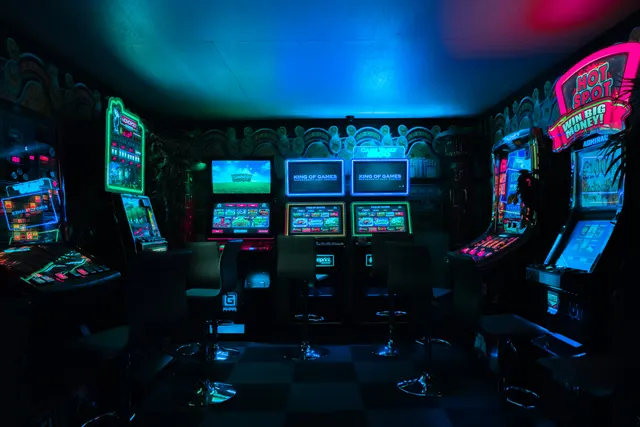
How Immersion, Presence, Emotion, & Workload Differ in Virtual Reality and Traditional Game Mediums
This study assesses the differences in emotion, immersion, and presence between virtual reality and traditional gaming experiences. It explores how these factors influence perceived workload and emotional responses, aiming to provide statistical support for the immersive qualities of virtual reality, with implications for military training and consumer applications.
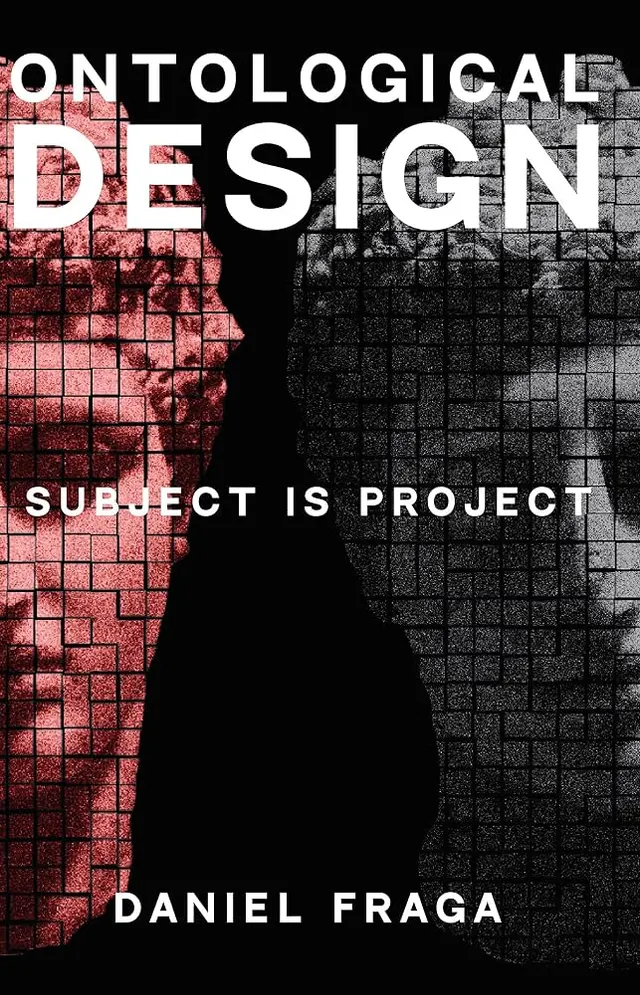
Ontological Design: Subject is Project
Ontological design focuses on designing human subjects through a feedback loop, emphasizing the need to adapt to the disruptions of technocapitalism. It frames the subject as a project influenced by social relations, behavior, and beliefs, aiming to engage with our sense of existence and reality while questioning and designing our understanding of it.

Research Cyberdelics: Context engineering psychedelics for altered traits
Cyberdelics and Cyberdelic Psychotherapy can enhance therapeutic psychedelic experiences through context engineering, which restructures perception and cognition. This approach aims to optimize psychedelic-assisted therapy by utilizing virtual and augmented environments, game mechanics, and principles from positive psychology and mindfulness, potentially aiding in personal growth and mental health recovery.
- Editor
- Not recorded yet
- Last reviewed
- Not reviewed yet
Conversation
Share your experience of it
What it was like, what helped, what you would tell someone before they try it.