Knowledge · Book
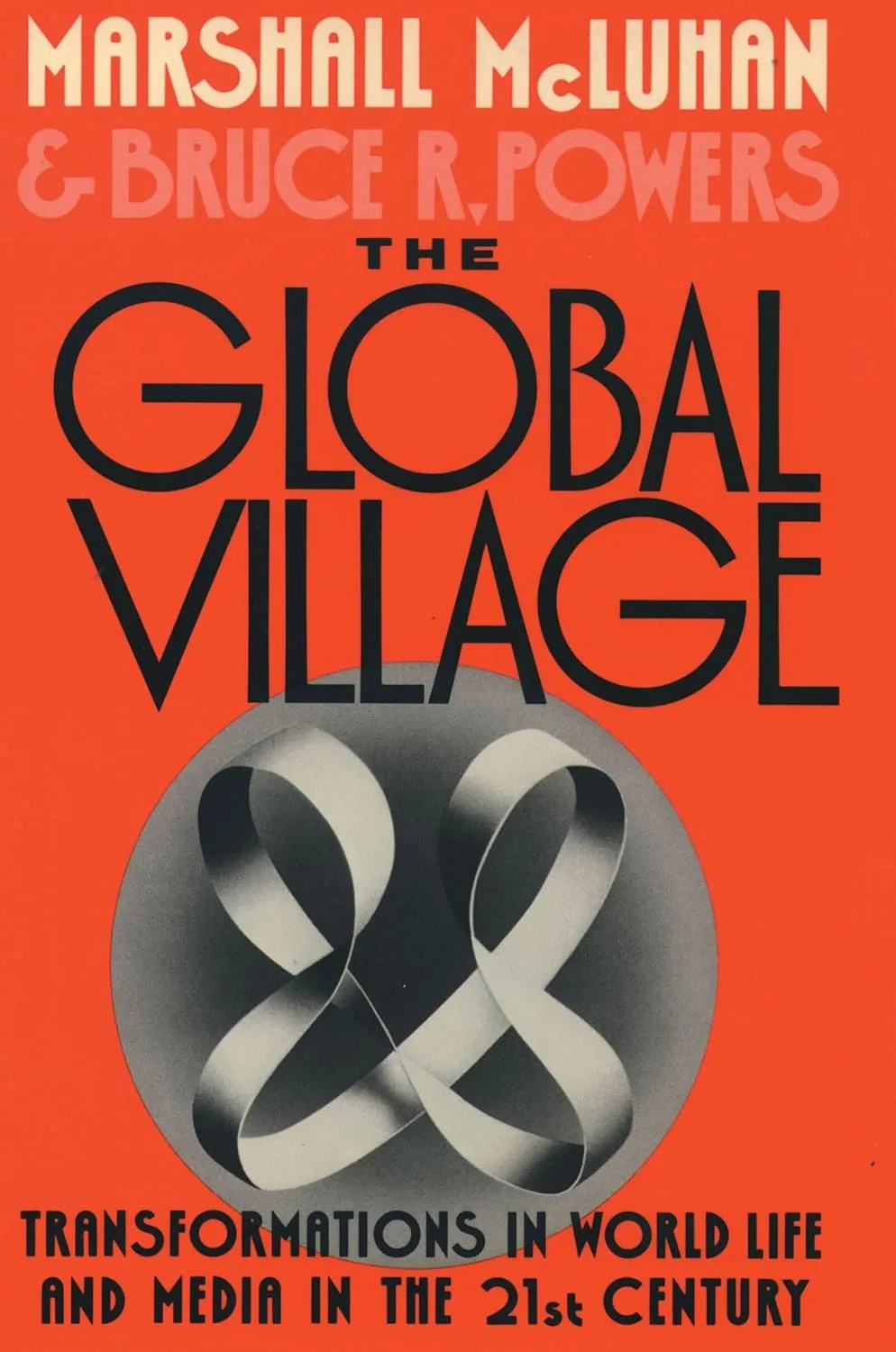
The Global Village: Transformations in World Life and Media in the 21st Century
By Marshall McLuhan, Bruce R. Powers
The authors explore the clash between Visual Space, a linear perception typical of the West, and Acoustic Space, a holistic view common in the East, in the context of today's global communications. They argue that technological advancements are pushing users towards a more dynamic understanding of the world, but warn that this transition may be challenging. Using McLuhan's Tetrad framework, they analyze the implications of these competing worldviews and emphasize the importance of understanding both to achieve peace.
- Kind
- BookFeatured21 books in the bank
- Published
- 1992Where it sits among everything in the Knowledge Bank, by year
- Authors
Topics
Summary
About the book
Extending the visionary early work of the late Marshall McLuhan,The Global Village , one of his last collaborative efforts, applies that vision to today's worldwide, integrated electronic network. When McLuhan's groundbreaking Understanding Media was published in 1964, the media as we know it today did not exist. But McLuhan's argument, that the technological extensions of human consciousness were racing ahead of our ability to understand their consequences, has never been more compelling. And if the medium is the message, as McLuhan maintained, then the message is becoming almost impossible to decipher.
In The Global Village, McLuhan and co-author Bruce R. Powers propose a detailed conceptual framework in terms of which the technological advances of the past two decades may be understood. At the heart of their theory is the argument that today's users of technology are caught between two very different ways of perceiving the world.
On the one hand there is what they refer to as Visual Space--the linear, quantitative mode of perception that is characteristic of the Western world; on the other hand there is Acoustic Space--the holistic, qualitative reasoning of the East. The medium of print, the authors argue, fosters and preserves the perception of Visual Space; but, like television, the technologies of the data base, the communications satellite, and the global media network are pushing their users towards the more dynamic, "many-centered" orientation of Acoustic Space.
The authors warn, however, that this movement towards Acoustic Space may not go smoothly. Indeed, McLuhan and Powers argue that with the advent of the global village--the result of worldwide communications--these two worldviews "are slamming into each other at the speed of light," asserting that "the key to peace is to understand both these systems simultaneously."
Employing McLuhan's concept of the Tetrad--a device for predicting the changes wrought by new technologies--the authors analyze this collision of viewpoints. Taking no sides, they seek to do today what McLuhan did so successfully twenty-five years ago--to look around the corner of the coming world, and to help us all be prepared for what we will find there.
Related
More like this
The Medium is the Massage
Marshall McLuhan's work emphasizes that media profoundly shape society beyond just their content, influencing personal and social aspects. Despite the enjoyment derived from mainstream media, it masks deeper societal anxieties due to incongruities between technology and society. His insights are increasingly relevant in the context of the digital revolution and the internet's rise.
Book
Eliott Edge explores virtual reality as a profound metaphor for human civilization, arguing that cultures themselves are forms of virtual realities shaped by language, religion, and societal beliefs. The collection of essays emphasizes that our perceptions and institutions create virtual worlds that influence our identity and existence, presenting an ontological awakening regarding our understanding of reality.
From Counterculture to Cyberculture
Fred Turner shows how the 1960s counterculture and the Whole Earth network influenced digital utopianism, virtual communities, and personal computing, highlighting the cultural link between psychedelic ideas and the rise of networked technology.
- Editor
- Not recorded yet
- Last reviewed
- Not reviewed yet
Conversation
Share your experience of it
What it was like, what helped, what you would tell someone before they try it.