Knowledge · Article
The Technodelic Manifesto
By Robin Arnott
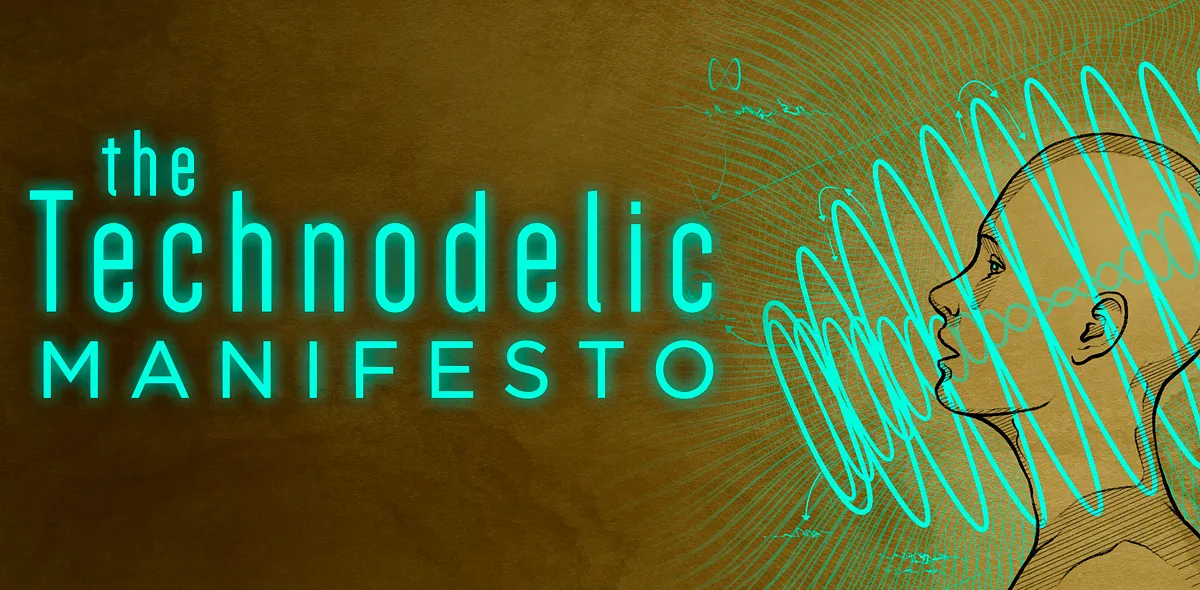
Technodelics aim to enhance mindfulness and connection in a world facing rising loneliness and depression. They focus on the present moment, using abstract audiovisual elements to stimulate the brain and engage the body in feedback loops. These experiences are immersive, reflective rather than prescriptive, and extend beyond screens into real-life settings, emphasizing the importance of ritual and ceremony.
- Kind
- Article33 articles in the bank
- Published
- 2020Where it sits among everything in the Knowledge Bank, by year
- Author
Topics
Summary
About the article
While for many in the Western world, material quality-of-life has been skyrocketing, rates of loneliness and depression are climbing to epidemic levels. These times call for mindfulness and connection. They demand we ask ourselves difficult questions about our practices and technologies, and the values they embody.
While technological means grow exponentially, the same cannot be said for our civilization’s core wisdom and values. Like every medium, games cannot help but express and respond to those values, and they do so with incredible technological sophistication. Game developers, with ever-deeper knowledge of player psychology, must choose to build ever-more efficient slot machines or ever-more polished mirrors.
The principles of a technodelic are:
- Technodelics are abstract, so as to negate the player’s critical thoughts. Words and stories are avoided wherever possible, in favor of geometry and music.
- Technodelics keep a player’s attention focused on the now. They will usually eschew the use of goals entirely, as goals tend to focus a player’s attention away from the present moment. Where goals are used, they are tied to on-going in-the-moment performance, and engineered to produce a flow state.
- Technodelics use the audiovisual field to invoke mystery and the sublime. Light and sound are used, not to describe objects, but to directly stimulate desired activity in the brain.
- Technodelics engage the player’s body in feedback loops. This creates a synesthetic relationship between sound, vision, and the player’s own biorhythms.
- Technodelics are unbiased feedback loops, meaning instead of rewarding certain behaviors and punishing others, they reflect all player expressions in myriad ways. Their systems are reflective rather than prescriptive. This both inspires a player’s sense of wonder, and turns that wonder inwards.
- Technodelics expand beyond the couch-and-screen into real-life set-and-setting. They make use of ritual and ceremony to amplify the depth of the experience.
- Technodelics are fully immersive experiences that require 100% of the player’s attention.
- Technodelics cannot be reductively designed. Instead, they must be intuitively channeled. Technodelic experiences are doorways to the ineffable, and the reasoning mind by definition cannot comprehend the ineffable.
Related
More like this
Art, Technology, Consciousness
The collection features articles from artists and scientists presented at the Third International CAiiA-STAR Research Conference, focusing on the intersection of art, technology, and consciousness. It explores diverse topics such as artificial life, immersive VR, and the nature of consciousness, emphasizing a multidisciplinary and multicultural approach. The aim is to raise key questions and pursue creative implications rather than provide definitive answers, while also considering the spiritual aspects of human experience and their artistic implications.

R.U. Sirius: Reality is up For Grabs | Team Human
Podcast episode featuring R.U. Sirius discussing themes of art, culture, cyberculture, psychedelics, psychology, and technology, emphasizing the idea that reality is open to interpretation and change. Available at Team Human's website.

The Global Village: Transformations in World Life and Media in the 21st Century
The authors explore the clash between Visual Space, a linear perception typical of the West, and Acoustic Space, a holistic view common in the East, in the context of today's global communications. They argue that technological advancements are pushing users towards a more dynamic understanding of the world, but warn that this transition may be challenging. Using McLuhan's Tetrad framework, they analyze the implications of these competing worldviews and emphasize the importance of understanding both to achieve peace.
- Editor
- Not recorded yet
- Last reviewed
- Not reviewed yet
Conversation
Share your experience of it
What it was like, what helped, what you would tell someone before they try it.